Every few years, the multi-cloud pitch gets a fresh coat of paint. In 2018 it was "portable containers." In 2020 it was "cloud-agnostic Kubernetes." In 2026, it's "run your AI workloads anywhere" and "avoid model lock-in." The vendors pushing the narrative change, the slide decks get prettier, but the fundamental promise remains the same: build once, run everywhere, and never commit to a single provider.
It looks compelling in a presentation. Forty-five minutes of clean architecture diagrams and vendor-neutral abstractions. Heads nod. Everyone feels good about optionality.
Then you try to build it. And that's where the pain starts.
After 220+ cloud engagements across healthcare, financial services, transportation, and technology — every single one on AWS — we can say with confidence: the organizations moving fastest are the ones that went deep, not wide.
First, Let's Define What We're Actually Talking About
Every company uses multiple cloud-based services. You probably use Microsoft 365 for email, Slack or Teams for chat, Salesforce for CRM, and AWS for infrastructure. That's not multi-cloud. That's just running a business.
Multi-cloud — the real, architectural version — means intentionally designing workloads to run across AWS, Azure, and GCP interchangeably. It means abstracting away the differentiated services of each platform so you can theoretically move between them. It means treating cloud providers as interchangeable utilities, like choosing between power companies.
That's the version we're going to talk about. And that's the version that consistently fails to deliver on its promises.
The Portability Tax
The fundamental problem with multi-cloud hasn't changed: when you architect for every platform simultaneously, you pay an abstraction tax on every decision. You can only use the capabilities that exist identically across all providers — and that intersection shrinks every year as platforms differentiate.
Six years later, this constraint is even more punishing. AWS now offers over 200 services purpose-built for specific workloads:
- AI and Generative AI — Amazon Bedrock gives you access to Claude, Llama, Mistral, Stable Diffusion, and Amazon's own models through a single API. Guardrails, knowledge bases, RAG pipelines, agent orchestration — all managed, all integrated with IAM, CloudWatch, and your VPC.
- Healthcare — HealthLake, Comprehend Medical, and HIPAA-eligible configurations across 100+ services. Try abstracting that into a "portable" layer.
- Data — Redshift, Glue, Athena, Lake Formation, OpenSearch, DynamoDB, Aurora — each purpose-built for different access patterns. A "cloud-agnostic" data layer means you get none of them.
- Security & Compliance — GuardDuty, Security Hub, Macie, Config, Organizations — an integrated security posture that doesn't exist if you're splitting workloads across three providers with three different identity models.
- Edge & Hybrid — Outposts, Local Zones, Wavelength, Snow Family. AWS meets you where you are without requiring you to bolt on a second provider.
Every one of these is a competitive advantage you surrender the moment you decide to "stay portable." Your competitor using Bedrock's knowledge bases shipped their AI feature last month. You're still writing the abstraction layer that lets you theoretically swap providers you're never going to swap.
"But Kubernetes Makes Everything Portable"
No. Kubernetes makes containers portable. It does not make:
- Your IAM policies portable
- Your data portable (good luck migrating a 50TB Redshift cluster to BigQuery over a weekend)
- Your compliance posture portable (HIPAA BAAs, SOC 2 scope, FedRAMP inheritance — none of it transfers)
- Your observability stack portable (CloudWatch alarms, X-Ray traces, Datadog integrations — all platform-specific)
- Your team's expertise portable (your engineers spent three years learning AWS networking; they don't magically understand Azure's networking model)
Kubernetes is a great orchestration layer. It is not a cloud abstraction layer, no matter how many vendor decks claim otherwise. The workload runs in a container, sure. Everything around it — networking, storage, identity, secrets, monitoring, compliance — is deeply platform-specific.
The AI Era Makes This Worse, Not Better
The newest flavor of the multi-cloud pitch is "model portability." Don't get locked into one AI provider. Build abstractions so you can swap models freely.
Here's the reality: the model is maybe 20% of a production AI system. The other 80% is:
- Data pipelines feeding the model (Glue, Kinesis, S3, Lake Formation)
- Vector stores for RAG (OpenSearch Serverless, Aurora pgvector)
- Orchestration (Bedrock Agents, Step Functions, Lambda)
- Guardrails and safety (Bedrock Guardrails, content filtering)
- Evaluation and monitoring (CloudWatch, custom metrics, A/B testing infrastructure)
- Security (IAM, VPC endpoints, KMS encryption, no-data-retention guarantees)
You can swap the model. Amazon Bedrock literally lets you do that with a parameter change — Claude today, Llama tomorrow. That's model flexibility within a platform, which is the right kind of flexibility. Building a "model-agnostic" layer that also abstracts away your data pipeline, security posture, and evaluation framework is a different project entirely — one that will take six months and deliver less functionality than what Bedrock gives you out of the box.
What We Actually See in the Wild
In 15+ years of AWS consulting, here's what "we're multi-cloud" actually means when we walk in the door:
- 85% of workloads on AWS (or Azure, depending on the primary), with a smattering of "shadow IT" deployments on the other provider that nobody fully understands
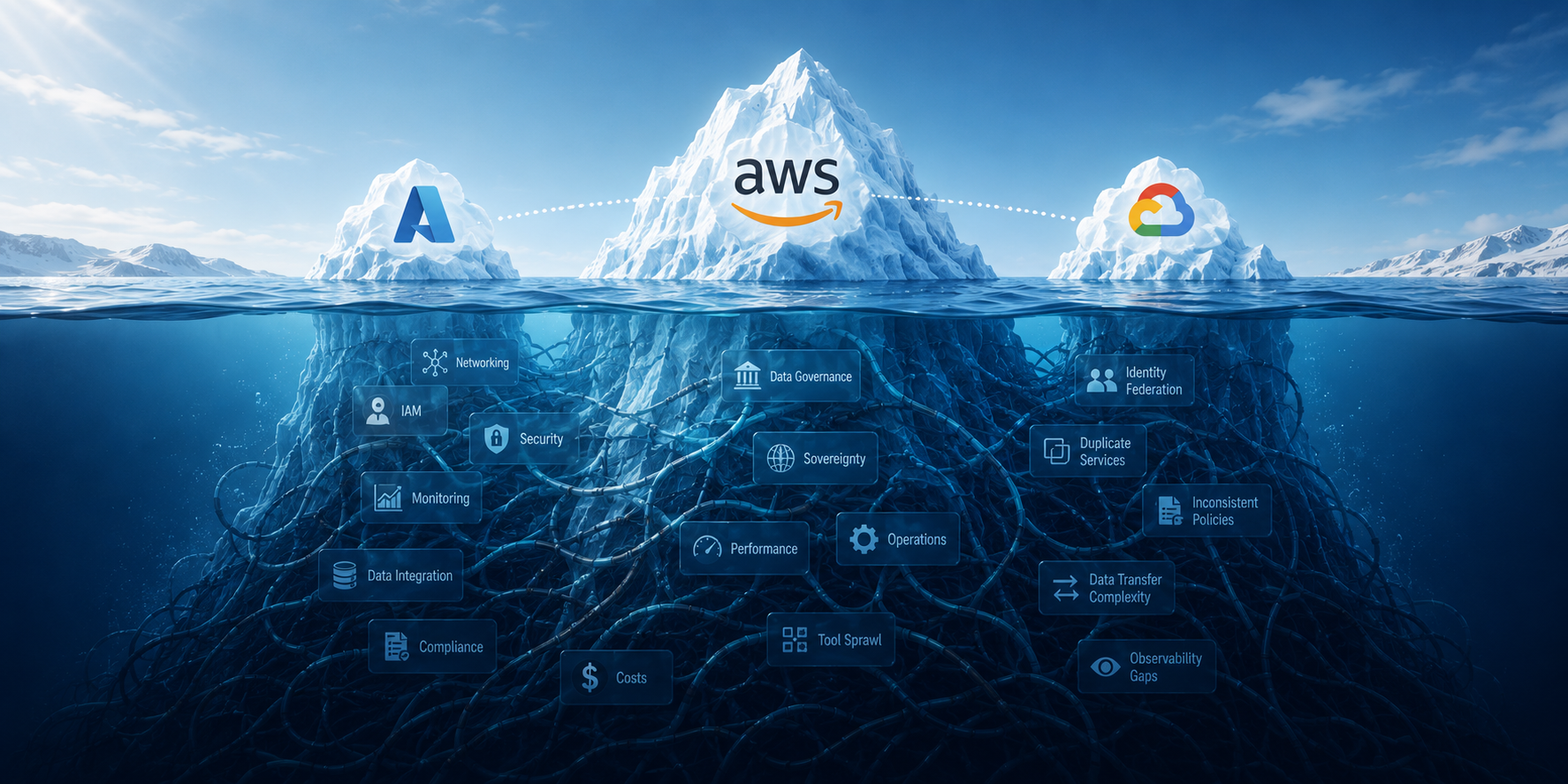
- Two sets of everything — two identity systems, two monitoring stacks, two sets of compliance documentation, two security teams that don't talk to each other
- Double the operational overhead at less than double the capability
- Engineers who are mediocre at two platforms instead of excellent at one
- Discount leverage that works against them — $5M in spend on one provider gets better pricing than $2.5M on each of two
The organizations that arrive at multi-cloud intentionally are rare. The ones that arrive there through acquisition, organizational politics, or "we started a POC on Azure in 2019 and never migrated it" are common. There's a difference between a strategy and an accident.
The Lock-In Argument Hasn't Aged Well Either
"What if we need to leave?" is the perennial concern. Let's be honest about what lock-in actually means in 2026:
Technical lock-in is real but overblown. Yes, DynamoDB's data model doesn't port to Cosmos DB without rework. But you chose DynamoDB because it gives you single-digit millisecond latency at any scale with zero operational burden. The "lock-in" is the value.
Economic lock-in is actually an advantage. Consolidated spend on one provider earns you better committed-use discounts, access to AWS funding programs (MAP credits, POC funding), co-sell partnerships, and a dedicated account team. We've helped customers unlock over $7M in AWS funding. That doesn't happen when you're splitting spend across three providers.
Talent lock-in is the one nobody talks about. Your engineers built deep AWS expertise. That expertise is transferable to any organization using AWS — which is most of them. "Multi-cloud engineer" isn't a career path anyone's hiring for at premium salaries. "Senior AWS Solutions Architect" absolutely is.
The exit math doesn't work anyway. Migrating from one cloud to another is a 12–24 month program that costs millions. If you're worried about needing to exit, the right insurance policy is clean architecture and well-documented systems — not an expensive abstraction layer that degrades your current capabilities.
When Multi-Provider Makes Sense
We're not dogmatic. There are legitimate reasons to use services from multiple providers:
- Best-of-breed SaaS — Datadog for observability, CrowdStrike for security, Vanta for compliance. These aren't multi-cloud; they're vendor selection. Use the best tool for each job.
- M&A situations — You acquired a company running on Azure. That's a temporary state, not an architecture decision. Migrate or integrate, but don't call it a strategy.
- Regulatory requirements — Certain data residency or sovereignty rules may require specific deployments. AWS usually handles this with regions and Local Zones, but edge cases exist.
- Genuine workload-specific advantage — If Google's TPUs are meaningfully better for a specific ML training workload and the economics justify the operational overhead, fine. But be honest: this applies to maybe 0.1% of organizations.
The key distinction: using multiple vendors is normal. Designing for interchangeability is where the trouble starts.
The Atayo Position
We're an AWS-exclusive shop. Not because we don't understand other platforms — we do. But because in 220+ engagements, we've never encountered a production workload that AWS couldn't support. Not once.
Healthcare compliance? AWS has more HIPAA-eligible services than any other provider. AI and generative AI? Bedrock, SageMaker, Comprehend, Rekognition — take your pick. Edge computing? Outposts. Mainframe migration? AWS Blu Age. Windows workloads? EC2 with dedicated hosts and license mobility. SAP? Certified and running at scale. Gaming? Millions of concurrent connections. IoT? Device management to analytics.
The breadth and depth of AWS in 2026 means the "but what if I need something AWS doesn't have" scenario is increasingly theoretical.
Going deep means our engineers know the platform cold. It means we've seen the failure modes. It means we can architect solutions that leverage the full power of the platform rather than sipping from the shallow end. It means our customers get outcomes faster because we're not debugging three providers' networking models simultaneously.
The Reality Check
If you're currently evaluating a multi-cloud strategy — or if a vendor is pitching you one — ask them this: show me a customer running true multi-cloud in production who's happy about it. Not a reference architecture. Not a demo. A real company, in production, at scale, that chose multi-cloud and would make the same decision again.
We've been asking for years. We're still waiting.
And if you're already deep on AWS and wondering whether the grass is greener, try this exercise: list every managed service you'd lose if you moved a single production workload to another provider. IAM policies. CloudWatch alarms. Security Hub findings. KMS keys. VPC configurations. Event-driven integrations. Now estimate what it would cost to rebuild all of that on a different platform — and ask whether that investment would be better spent building something your customers actually care about.
If multi-region on a single platform is hard, multi-cloud is exponentially harder. Spend that engineering effort on the thing that actually differentiates your business.
Get Started
If your organization is evaluating cloud strategy — whether it's consolidating a multi-cloud accident into a coherent AWS foundation or going deeper on the platform you're already on — we'd welcome the conversation.
Talk to an Atayo architect about your cloud strategy, or explore our AWS competencies to see the depth we bring.
Tags
Atayo Group
AWS-certified cloud practitioners delivering end-to-end cloud solutions and services.
About Atayo →