
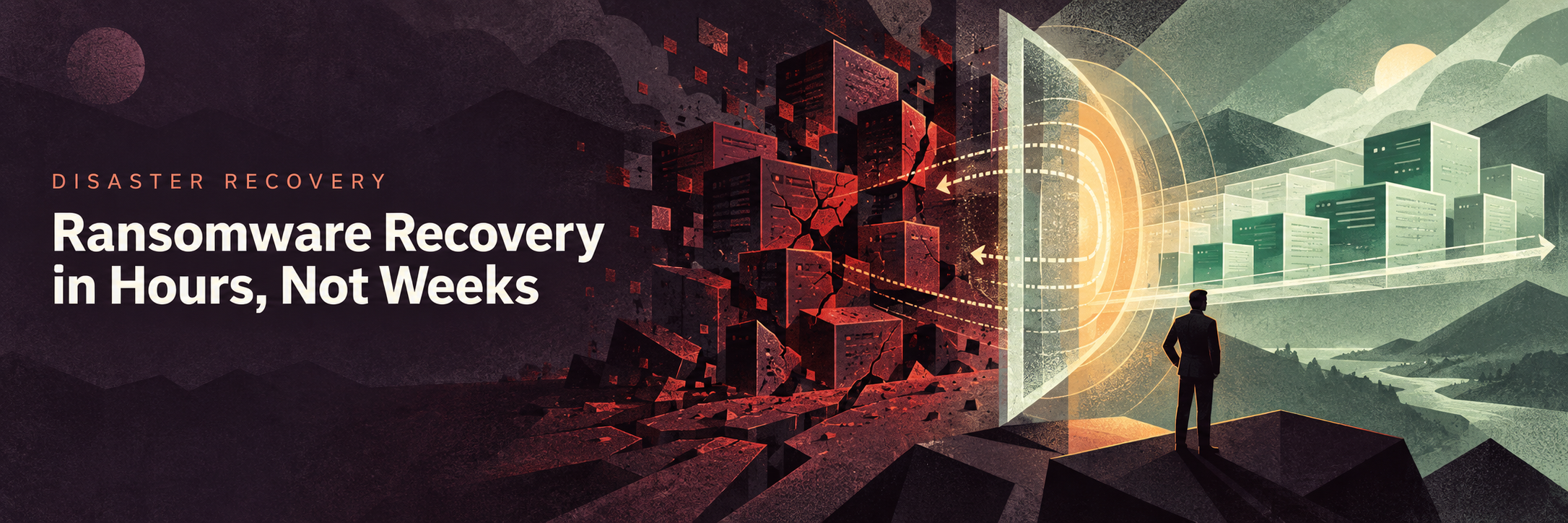
Ransomware attacks aren't slowing down. "Ransomware as a service" has lowered the barrier for attackers, and the impact on organizations — especially in healthcare, government, and critical services — can be catastrophic. Hospitals go offline. Public services halt. Data is encrypted, exfiltrated, or both.
Most organizations have some combination of antivirus and backup in place. But these are point solutions that operate independently and require manual coordination when an actual incident occurs. Traditional antivirus relies on signatures, which means it's always one step behind new threats. And traditional backup/restore? It takes days to weeks to get critical systems back online — if the backups themselves haven't been compromised.
The reality is that most organizations have never actually tested their disaster recovery under a ransomware scenario. They don't know their true RPO or RTO. They don't know if their backups are clean. And they don't have an integrated playbook that connects detection to recovery.
There's a better way.
The Integrated Approach: Detect, Protect, Recover
The fundamental shift is moving from independent, manually coordinated tools to an integrated response chain that connects threat detection directly to disaster recovery orchestration. Instead of detecting an attack, then scrambling to figure out what to restore and from when, the system identifies the infection point-in-time and rolls back to a clean state automatically.
This approach aligns with the NIST Cybersecurity Framework pillars — Identify, Protect, Detect, Respond, and Recover — but treats them as a connected system rather than independent checkboxes.
The key components:
CrowdStrike Falcon — Next-generation antivirus (NGAV) combined with endpoint detection and response (EDR). Unlike signature-based antivirus, CrowdStrike observes kernel-level activity in real time, flagging behavior indicative of ransomware (file system enumeration, shadow backup deletion, encryption routine calls). When an attack penetrates the NGAV layer, EDR reports the exact point-in-time the suspect activity began.
AWS Elastic Disaster Recovery (AWS DRS) — Continuously replicates your servers to an isolated AWS staging area with snapshot intervals as low as 10 minutes. This gives you granular point-in-time recovery options — you can roll back to minutes before the infection, not days.
Orchestration Layer — Middleware that connects CrowdStrike's detection events to AWS DRS failover actions. When an intrusion is detected, the orchestration layer identifies affected workloads, quarantines compromised endpoints, and triggers a failover to a clean recovery point — all within a coordinated, auditable workflow.
The result: business operations restored in hours instead of days or weeks. No ransom paid. No data loss beyond the minutes between the last clean snapshot and the infection.
How Atayo Delivers This
Atayo was part of the team that built and launched this integrated ransomware mitigation approach — co-authoring the solution architecture with AWS, Presidio, and CrowdStrike and deploying it for customers across healthcare, government, and enterprise environments.
Here's what an Atayo implementation looks like in practice:
1. Foundation: Secure Landing Zone
Every engagement starts with a properly architected AWS environment. We deploy AWS Control Tower with security guardrails, isolated recovery accounts, and network segmentation that ensures the recovery environment is unreachable from the production network. A ransomware response solution is only as good as the foundation it runs on.
2. Continuous Replication
AWS DRS agents are deployed on production servers — whether they're on-premises, in a co-location facility, or already in AWS. These agents continuously replicate block-level changes to an isolated AWS staging area. Unlike traditional backup solutions that run on a schedule (nightly, weekly), AWS DRS provides continuous replication with recovery points available at sub-hourly intervals.
3. CrowdStrike Integration
CrowdStrike Falcon is deployed across all protected endpoints, providing real-time behavioral analysis. When the EDR detects ransomware activity, it reports the exact timestamp of the first indicator of compromise — this becomes the reference point for recovery.
4. Orchestrated Response
When an incident is detected, the response workflow fires automatically: affected servers are quarantined in CrowdStrike (preventing lateral movement), the incident response team is notified with context about affected workloads and available recovery points, and upon approval, AWS DRS launches a failover to a point-in-time just before the infection.
5. Managed Operations
Atayo's managed security practice provides 24/7 monitoring across the entire stack — CrowdStrike alerts, AWS Security Hub findings, and DRS replication health. Our team validates that replication is healthy, conducts regular failover testing, and maintains the runbooks that govern incident response.
Real Results: 75 Servers Recovered, $0 Ransom Paid
This isn't theoretical. When one of our customers — an enterprise technology company running 75 on-premises Windows Server workloads — was hit by a ransomware attack, the integrated approach delivered exactly as designed:
- Tier-one workloads back online within 24 hours — critical business systems were operational the next day
- 95% of the environment recovered within 3 days — 75 servers restored from clean AWS recovery points
- Zero ransom paid — full recovery from pre-infection snapshots eliminated any leverage the attackers had
- Improved RPO/RTO vs. their legacy DR — their previous co-location DR solution required 24 hours advance notice for failover and had never been tested
The customer's previous DR solution — a third-party service replicating to a co-location facility — had never been tested in a live scenario and required advance notification before any failover could occur. When ransomware struck, that solution was useless. The AWS DRS-based approach Atayo had deployed was the difference between a multi-week outage (or paying the ransom) and a measured, controlled recovery.
As Jeromey Brown, Atayo's Director of Cloud Services, noted: "We usually get parachuted into ransomware cases that are much harder to recover from. This customer was very lucky that their on-prem environment was replicated into an isolated area on AWS. I wish we had that for all ransomware cases."
Why This Beats Traditional DR
| Traditional Approach | Integrated Approach (AWS DRS + CrowdStrike) |
|---|---|
| Nightly or weekly backups | Continuous replication (sub-hourly RPO) |
| Signature-based AV (reactive) | Behavioral EDR (real-time detection) |
| Manual coordination between tools | Automated orchestration layer |
| Recovery takes days to weeks | Critical workloads online in hours |
| Backups may be compromised | Isolated staging area, unreachable from production |
| DR rarely or never tested | Regular, non-disruptive failover testing |
| No clear incident timeline | EDR provides exact point-in-time of compromise |
The traditional model treats backup and security as separate concerns. This approach treats them as one connected system — detection informs recovery, and recovery is pre-staged and ready to execute at any moment.
Getting Started
If your current DR strategy has never been tested under a ransomware scenario — or if your recovery time is measured in days rather than hours — it's worth evaluating this approach. Here's where to start:
Assess your current posture — Do you know your actual RPO and RTO for critical workloads? Have you tested a full DR failover? Are your backups isolated from your production network?
Read the technical architecture — The full solution architecture on the AWS Partner Network blog walks through the component-level design, including the DRS Orchestration Layer and CrowdStrike integration patterns.
Talk to our team — Atayo's security and DR practice can assess your environment, design an integrated ransomware mitigation solution, and deploy it as part of our managed services model. Contact us to start the conversation.
Ransomware preparedness isn't about if — it's about when. The organizations that recover fastest are the ones that invested in an integrated, tested, pre-staged response before the attack arrived.
Tags
Atayo Group
AWS-certified cloud practitioners delivering end-to-end cloud solutions and services.
About Atayo →